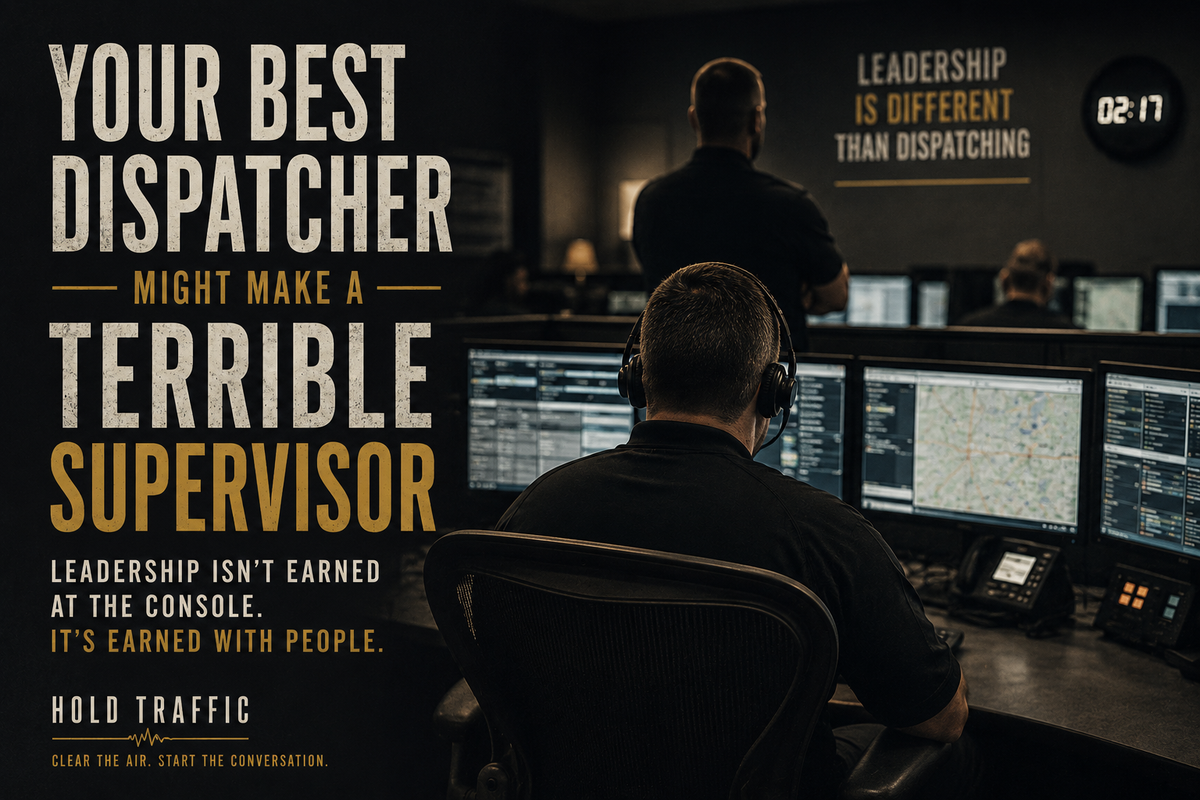
Your Best Dispatcher Might Make a Terrible Supervisor
Being great behind the console doesn’t automatically make someone a great leader. The skills that make an exceptional dispatcher and the skills required to lead people aren’t always the same and promotion should be the beginning of leadership development, not the end.

Every dispatch center has one.
The dispatcher who can handle anything.
They can work the busiest radio in the room while answering a 911 call, helping the new person beside them, and somehow still noticing that someone entered the wrong address into CAD.
When the chips are down and everything goes sideways, they’re the person everyone wants sitting at the console.
They’re experienced. They’re confident. They know policy. Officers trust them. Firefighters recognize their voice. Other dispatchers go to them when they don’t know what to do.
Eventually someone says the obvious thing:
“They’d make a great supervisor.”
Maybe.
Or… hear me out here.…maybe not.
Being an excellent dispatcher and being an excellent supervisor are two very different things.
And sometimes we don’t recognize that until after we’ve promoted someone.
We Promote What We Can See
It makes sense that strong dispatchers get considered for promotion.
Technical competence matters.
A supervisor needs credibility. They need to understand the work they’re supervising, and when something serious happens, everyone in the room needs confidence that the person in charge understands what’s happening.
But technical ability is also incredibly easy to see.
We know who can handle the radio. We know who understands CAD. We know who knows policy without looking it up. We know who can manage a major incident without falling apart.
Those things are visible every day.
Leadership ability can be harder to spot.
Can this person have a difficult conversation with someone they like?Can they coach someone who doesn’t learn the way they do? Can they make a decision that they know won’t be popular? Can they listen before deciding they’re right? Can they give someone credit without needing any themselves?Can they enforce a standard consistently when their friend is the person who violated it? Can they admit they made the wrong call?
Those skills don’t always show themselves while someone is working a radio.
But they will show themselves very quickly once that person becomes a supervisor.
The Job Changes
We spend months teaching someone how to become a dispatcher and sometimes years helping them become a great one.
Then we promote them to supervisor, hand them the keys and access to the scheduling software, and wonder why they’re struggling.
We wouldn’t put someone on a radio without training them.
We wouldn’t put someone on a 911 phone after saying, “You’ve watched other people answer phones for years. You’ll figure it out. Go get em Champ!”
Yet organizations do something surprisingly similar with supervisors all the time.
We assume they’ve been around long enough to know how supervision works.
But supervision is a different job.
As a dispatcher, you’re primarily responsible for your performance.
As a supervisor, you’re responsible for helping other people perform.
That’s a major shift.
Your value isn’t measured by whether you’re the fastest person in CAD anymore. Sometimes your job is to make the person sitting beside you better at CAD.
Sometimes it’s figuring out why they’re struggling.
Sometimes it’s telling a dispatcher you’ve worked beside for ten years that their performance isn’t meeting the standard.
And sometimes it’s realizing that the person you’re supervising may eventually become better at something than you are.
A good supervisor should be okay with that.
In fact, they should want it.
Your Friends Are Still Your Friends….But Something Changed
The transition from peer to supervisor may be one of the hardest leadership transitions in public safety communications.
Yesterday you were complaining about management together.
Today you are management.
That’s….awkward.
You’re still working with people whose weddings you’ve attended, whose kids you know, and who know exactly what you said about the last policy change.
You don’t suddenly stop caring about those relationships because your title changed.
Nor should you.
But something has changed.
You now have an obligation to the entire team that sometimes has to outweigh your obligation to a friendship.
That’s where new supervisors can get into trouble.
Some become overly strict because they’re determined to prove they aren’t showing favoritism.
Others go the opposite direction and avoid addressing problems because they don’t want their friends to think they’ve changed.
Neither works.
Leadership doesn’t require you to stop being someone’s friend.
It does require you to be fair.
And fair doesn’t mean everyone gets whatever keeps them happy.
The Superstar Trap
There’s another challenge that sometimes comes with promoting the strongest dispatcher in the room.
They’re used to being good at things.
Really good.
Then suddenly they’re doing something they’re not good at yet.
That’s uncomfortable.
When you’ve spent years being the person everyone asks for help, it can be difficult to become the person who needs help.
Some new supervisors compensate by falling back on what they know.
They keep being the superstar dispatcher.
They jump onto every difficult call.
They take over radios.
They solve everyone’s problems.
And everybody loves them for it.
At first.
But eventually you’ve created a supervisor who is still functioning as the strongest dispatcher on the shift instead of developing a stronger shift.
There’s a difference.
There will absolutely be times when a supervisor needs to put on the headset and get into the fight. This is 911. When things go bad, we all pitch in.
But if the supervisor always takes over the difficult work, nobody else gets better at doing difficult work.
Leadership sometimes means resisting the urge to show everyone that you can solve the problem.
Instead, you help someone else learn how to solve it.
Being Respected Is Different From Being Liked
Most people want their coworkers to like them.
That’s normal.
But supervisors who need to be liked eventually have a problem.
Because leadership occasionally requires disappointing people.
Someone isn’t getting the day off.
Someone isn’t ready to be released from training.
Someone’s performance needs improvement.
Someone violated a policy.
Someone isn’t carrying their share of the workload.
Someone needs to hear something they don’t want to hear.
Avoiding that conversation doesn’t make you a compassionate supervisor.
It usually means another dispatcher has to deal with the consequences.
That’s something I think new leaders sometimes miss.
When we refuse to address poor performance because we don’t want to upset one person, we’re making everyone else carry it.
Good employees notice.
They always notice.
You don’t have to enjoy difficult conversations. I know I don’t.
I don’t know many good leaders who do.
You just have to be willing to have them.
So What Should We Look For?
Technical competence should absolutely be part of the equation.
But I’d also pay attention to the dispatcher people naturally trust.
Not necessarily the loudest person.
Not necessarily the person with the most seniority.
And not necessarily the person who wants the title the most.
Watch what happens when someone makes a mistake.
Does this person teach them or embarrass them?
Watch what happens when there’s a disagreement.
Do they immediately pick a side, or do they ask questions?
Watch how they treat a trainee who isn’t catching on quickly.
Watch what they do when nobody in management is around.
Watch whether they bring solutions or simply collect complaints.
Can they can disagree with a decision and still carry it out professionally.
And pay particular attention to what they do when they’re wrong.
Those things tell you something about the leader you’re considering promoting.
Promotion Isn’t the Finish Line
Even if we select the right person, our responsibility isn’t finished.
A new supervisor needs training.
Real training.
Not just instruction on approving timecards, completing evaluations, and filling out forms.
They need to learn about communication, coaching, conflict, documentation, accountability, decision-making, employment issues, organizational culture, and how to transition from being one of the group to being responsible for the group.
They need mentors.
They need opportunities to make smaller leadership decisions before they’re dealing with major ones.
And they need someone they can call and say:
“I have absolutely no idea what to do here.”
without feeling like admitting that means they shouldn’t have been promoted.
We expect that from trainees.
We should allow it from developing leaders too.
Your Best Dispatcher Might Be Your Best Supervisor
None of this means we shouldn’t promote great dispatchers.
Your best dispatcher might become an outstanding supervisor.
The experience, confidence, technical knowledge, and credibility they bring can become tremendous leadership assets.
But those things are the foundation.
They’re not the finished product.
Working three radio channels at once doesn’t teach you how to coach someone through a performance problem.
Knowing every policy in the manual doesn’t teach you how to earn trust.
Being the person everyone depends on during a critical incident doesn’t automatically teach you how to develop people who can someday handle that incident without you.
Those are different skills.
And if we want better leadership in public safety communications, we need to start treating them that way.
Selecting someone for promotion isn’t the end of their development.
It’s the beginning of an entirely different kind of training.