Nobody Calls 911 to Tell You You're Doing a Great Job
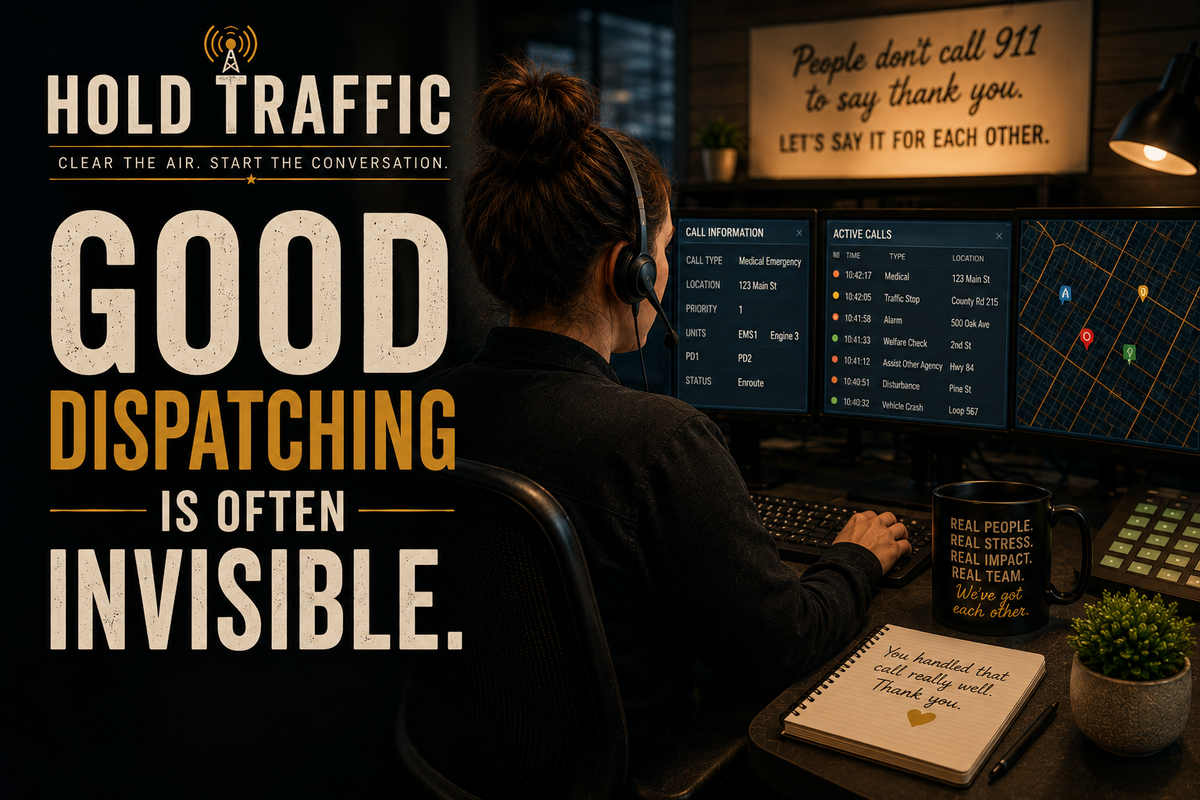
In dispatch, doing everything right often means nothing memorable happens. Good work can become invisible simply because we expect it. Maybe it’s time we got better at noticing the people quietly getting it right, shift after shift.

Nobody calls 911 to tell you you're doing a great job.
Think about it.
Nobody picks up the phone on a quiet Tuesday afternoon, dials 911, and says:
“Hey, I don't have an emergency. I just wanted you guys to know you're really killing it today.”
At least I hope they don't.
People call us because something is wrong.
Sometimes terribly wrong.
They need an ambulance. Their house is on fire. Someone is trying to get into their home. They've been in a wreck. Their child is missing. Someone they love isn't breathing.
Or maybe their neighbor's dog is loose again.
The definition of emergency can get a little flexible.
Either way, public safety communications operates in an environment where most interactions begin with a problem.
And that creates an interesting problem of its own.
How often do the people behind the console hear that they're doing something right?
We Notice Problems
Public safety is very good at finding mistakes.
Honestly, we have to be.
A wrong address matters.
Missing information matters.
Sending the wrong resource matters.
A radio transmission that doesn't get acknowledged matters.
Documentation matters.
Policy matters.
Quality assurance programs exist specifically to examine performance and identify areas where we can improve.
Supervisors address mistakes.
Trainers correct trainees.
Responders call when something didn't go the way they expected.
Sometimes callers complain.
And occasionally someone will happily explain exactly how dispatch should operate despite having learned everything they know about 911 from television.
Feedback is part of the job.
Accountability should be part of the job.
But there's a natural imbalance.
Problems announce themselves.
Good performance usually doesn't.
Doing Everything Right Can Be Pretty Boring
Some of the best dispatching isn't dramatic.
There's no recording that gets played at an awards banquet.
Nobody writes an article about it.
It doesn't end up on social media.
A dispatcher answers the phone.
They determine where the emergency is.
They figure out what's happening.
They ask the right questions.
They enter accurate information.
They send the appropriate resources.
They update responders.
They document what needs documenting.
Then they disconnect and answer the next call.
That's it.
Nothing spectacular happened.
Which is kind of the point.
In dispatch, doing everything right often means nothing memorable happens.
The right people went to the right place with the right information.
That's what was supposed to happen.
Now do it again.
And again.
And again.
For eight, ten, or twelve hours.
That's professional excellence too.
We just don't always recognize it because it looks like normal operations.
Competence Becomes Invisible
There's a strange thing that happens when someone becomes really good at their job.
We stop noticing.
Think about the dispatcher who has worked the same radio for years.
They know the responders.
They know the geography.
They recognize when something about a call doesn't sound right.
They hear a unit transmit and can tell from the tone of their voice that something has changed.
They anticipate what's going to be needed before someone asks.
They catch mistakes quietly.
They help the person beside them without making a production out of it.
They make difficult things look routine.
Eventually, everyone simply expects it.
That's the danger of competence.
The better someone becomes at making the job look easy, the easier it becomes to forget that the job isn't easy.
Then one day they're gone.
They're on vacation.
They move shifts.
They promote.
They leave the agency.
And suddenly everyone realizes how many little things they were handling that nobody ever noticed.
We shouldn't have to lose good people before we recognize what they were contributing.
Recognition Doesn't Have to Be an Award
When we talk about employee recognition, organizations sometimes immediately start thinking about programs.
Employee of the Month.
Certificates.
Awards.
Pins.
Plaques.
Banquets.
Those things can be meaningful.
I'm not against any of them.
But I don't think recognition always needs a program.
Sometimes it needs a sentence.
“You handled that really well.”
“I noticed what you did there.”
“Thanks for helping them through that call.”
“That was a rough radio. Good job keeping it together.”
“I appreciate you.”
Those conversations take seconds.
And they're especially important when they're specific.
There's a big difference between:
“Good job today.”
and:
“I heard how you slowed that caller down and got the address when they were panicking. You handled that really well.”
The second tells someone you actually noticed.
That's powerful.
Not Everything Needs a Trophy
There's another side to this conversation.
Recognition shouldn't become meaningless.
If everything deserves an award, eventually nothing does.
Public safety communications is a professional environment. Doing your job correctly is an expectation.
We don't need a ceremony every time someone answers a 911 call correctly.
And employees shouldn't require constant praise to meet basic standards.
That's not what I'm arguing.
I'm talking about something simpler.
Notice people.
Notice improvement.
Notice effort.
Notice when someone helps a coworker.
Notice when the dispatcher who struggled with something six months ago handles it confidently today.
Notice the experienced person who quietly keeps the room functioning during a difficult shift.
Notice the employee who consistently does the little things correctly even when nobody is watching.
Recognition doesn't lower the standard.
Done correctly, it reinforces it.
You're telling people:
This is what good looks like. Keep doing this.
Dispatchers Should Notice Each Other Too
This isn't only a leadership responsibility.
Some of the best recognition comes from the person sitting at the next console.
Dispatchers understand things about each other's work that supervisors sometimes won't see.
You know when the radio was brutal.
You heard the call.
You saw them juggling three things at once.
You noticed when they stepped in to help you.
Say something.
Public safety has an interesting habit of using sarcasm as affection.
Sometimes:
“You didn't completely screw that up.”
is practically a standing ovation.
And honestly, I don't want to lose that part of our culture.
But every once in a while, maybe just say the actual thing.
“You did a good job.”
It won't kill you.
Probably.
The Calls We Remember
Every dispatcher eventually accumulates calls they remember.
Some because they were terrible.
Some because they were unusual.
Some because they were funny.
Some because something went wrong.
And occasionally because something went exactly right when it absolutely had to.
Those moments matter.
They deserve recognition.
But a career in dispatch isn't built primarily from extraordinary calls.
It's built from thousands and thousands of ordinary ones.
Traffic stops.
Alarm calls.
Medical calls.
Disturbances.
Welfare checks.
Warrants.
Vehicle crashes.
Administrative requests.
Phone calls.
Radio transmissions.
CAD entries.
One after another.
Year after year.
Professionalism is doing those things correctly even when nobody is watching and nobody is going to remember the call tomorrow.
That's the part of the profession I think we sometimes overlook.
Tell Them Now
If you're responsible for leading people, don't wait for an annual evaluation to tell someone they're doing good work.
Don't assume they know.
And don't let the only time you pull someone aside be when something went wrong.
Correct mistakes.
Maintain standards.
Hold people accountable.
Those things matter.
But notice good work with the same intentionality that you notice bad work.
And if you're sitting behind a console, notice the people around you too.
The public probably isn't going to call and tell your coworker they handled sixty routine calls professionally today.
The officer who received exactly the information they needed probably won't think twice about how it got there.
Nobody is going to send a thank-you card because every unit status was correct and every radio transmission was acknowledged.
That's okay.
We know what good dispatching looks like.
We know this job isn't easy.
And sometimes we should remind each other of that.
Because nobody calls 911 to tell you you're doing a great job.
Maybe we should.
Well...
Don't actually call 911.
Just tell the dispatcher.